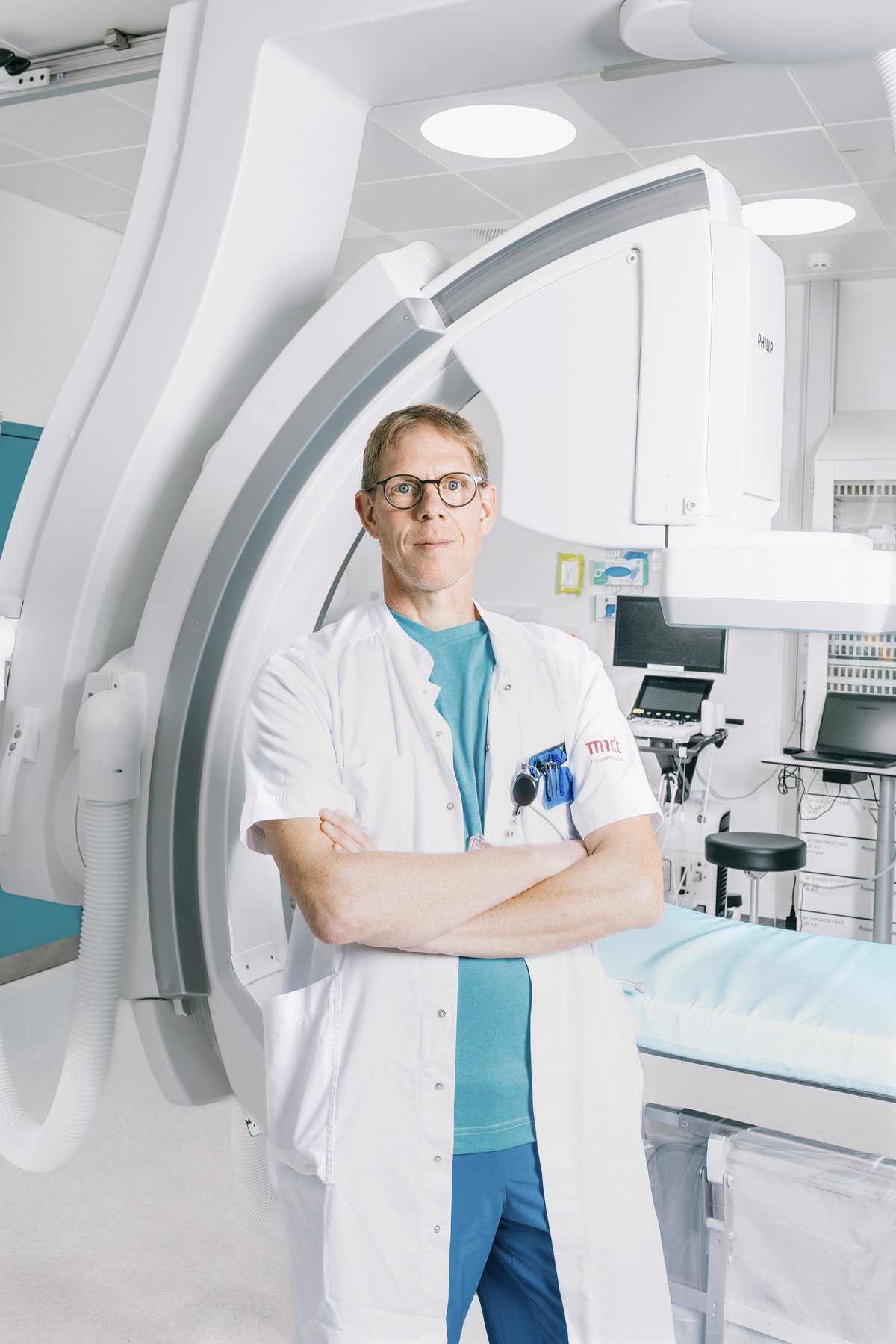
To address this challenge, engineers from the Department of Electrical and Computer Engineering (ECE) at Aarhus University collaborated with clinicians from Aarhus University Hospital (AUH).
Coronary artery disease is the most common form of heart disease and is often treated using balloon angioplasty and stenting. In some patients, however, the coronary arteries are heavily calcified, which increases the risk of rupture. In these cases, a covered stent may be used. However, when the narrowing is located at a branch point, the covered stent can obstruct blood flow to side branches. Consequently, there has been a need for a method to safely and realistically test how blood flow can be maintained in such situations without involving patients.
The Cardiovascular Experimental Laboratory (CAVE Lab) at ECE has many years of specialised experience and expertise in developing physical heart models for testing and evaluating implants and procedures. Based on the clinical challenge posed by calcified coronary arteries, researchers at CAVE Lab established a series of student projects that led to the development of a coronary artery model based on CT imaging and 3D printing.
The model was used to simulate a high-risk procedure. Using a covered stent, the team successfully restored blood flow to the blocked side branch in the laboratory – something that had previously not been possible to test safely and under controlled conditions.
Only a few weeks after laboratory test in ECE’s CAVE Lab, the technique was successfully used in a patient.
The solution is based on physical heart models that realistically replicate both the anatomy and the mechanical properties of the coronary arteries. By combining imaging data from CT scans with advanced 3D printing, researchers can develop models that make it possible to test complex catheter-based procedures under controlled conditions.
This approach enables clinicians to test procedures and assess the associated risks in cases that cannot otherwise be simulated in advance, before treatment is carried out on a patient.
The model-based testing in ECE’s CAVE Lab enabled clinicians to review the procedure step by step and assess it under realistic, controlled conditions before it was used on a patient.
This gave clinicians a significantly better basis for planning and performing a complex procedure under particularly challenging anatomical conditions. It has already had a direct impact on several patients and opens up a new approach to testing and preparing coronary interventions and catheter-based techniques.
"The model allowed us to test an acute procedure step by step in a realistic environment. It helped us move from a theoretical possibility to a decisive technique applied in clinical practice," explains Lars Jakobsen, Consultant Cardiologist and PhD at AUH.
"It is truly unique that something we develop in the laboratory can find its way into clinical practice so quickly. It demonstrates the potential of close collaboration between clinicians and engineers," says Peter Johansen, Associate Professor at ECE and Head of CAVE Lab.
In addition, the project has attracted increased attention from clinical collaborators and inspired new research projects – all without support from major foundations, but driven by student projects and academic engagement.
This collaboration is a clear example of the value of connecting engineering expertise, clinical needs, and rapid testing.
JACC: Case Reports: https://doi.org/10.1016/j.jaccas.2025.103382
Emil Nielsen Holck, MD, PhD
Lene Nyhus Andreasen, MD, PhD
Jesper Skovhus Thomsen, MSc, PhD, DSc
Evald Høj Christiansen, MD, PhD
Emilie Kjær Hansen, BSc
Annemarie Brüel, MD, PhD, DSc
Lars Jakobsen, MD, PhD
Former students who contributed
Tobias Brinck Erichsen
Kimmie Lisborg Frydenberg
Christiane Nørkjær Svendsen
Kajene Elankanathan
Zafercan Dedeoglu
Anisa Mohamed Hassan
Peter Ha van Thien Son
Frederik Aksel Holst