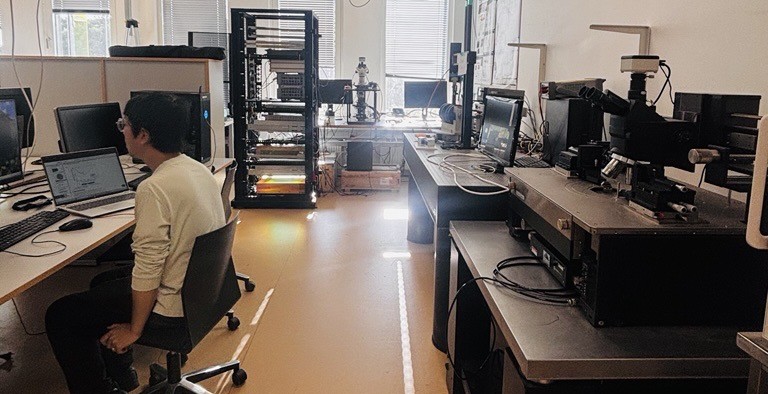

The Material-Inspired Nano Devices and Systems (MINDS) Lab in Biomedical Section at Electrical and Computer Engineering Department, Aarhus University investigates how emerging magnetic materials and nanoscale spintronic devices (such as MRAM, Spin nano oscillators, Magnetic tunnel junction) can be transformed into functional computing technologies. Our research bridges materials physics, spintronic device engineering, advanced characterization, physics-informed modelling, and circuit-to-system design, with a particular focus on exploiting the intrinsic dynamics of magnetic systems for energy-efficient information processing.
We study a broad range of magnetic phenomena, including magnetization switching, stochastic dynamics, nonlinear oscillations, synchronization, and topological spin textures such as magnetic vortex, skyrmions. These phenomena are investigated not only as fundamental physical effects, but also as potential computational resources for neuromorphic, probabilistic, in-memory, and edge-intelligent computing.
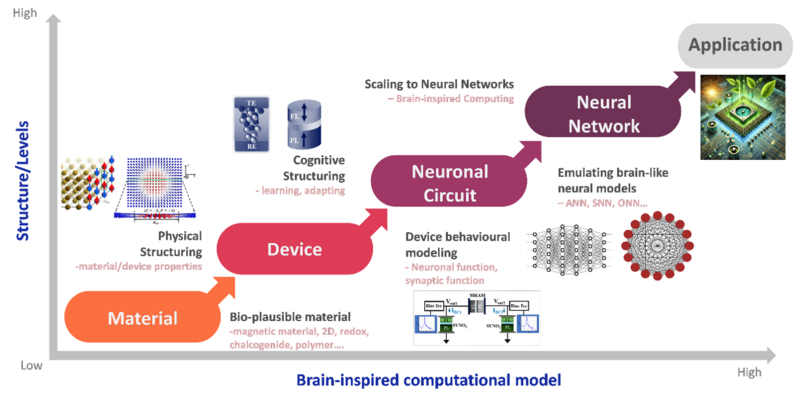
A key strength of MINDS Lab is its multiscale physics-to-hardware approach. We develop and experimentally validate device-level models that capture the relevant magnetic dynamics, including stochasticity, variability, nonlinear behavior, and phase noise. These models are translated into EDA-compatible compact models and used for circuit- and architecture-level exploration of spintronic computing systems, including spiking and oscillatory neural networks and probabilistic computing architectures.
The laboratory develops advanced capabilities for electrical, magnetic, dynamic characterization of nanoscale spintronic devices, and high performance computing workstation along with the possibilities to access to nanofabrication facilities at Aarhus University and through national and international collaborations. By combining experimental characterization, modelling, and hardware-aware design, MINDS Lab aims to accelerate the translation of emerging magnetic phenomena into scalable, energy-efficient computing technologies.
The long-term vision of MINDS Lab is to establish a research platform that connects materials properties → devices → compact models → circuits → intelligent systems, enabling new approaches to low-power storage and computing beyond conventional electronics.
