We are currently offering Master's, Bachelor's, and R&D engineering projects with wireless communications, networking and data analytics.
This project examines whether open satellite radar imagery, pretrained AI models and Automatic Identification System (AIS) data can be combined to detect vessels that do not report their position, so called dark vessels. Ships are detected in Sentinel 1 synthetic aperture radar (SAR) images, matched against AIS tracks, and unidentified vessels are shown with alerts in the Team Awareness Kit (TAK), a common operational picture used by defence and emergency services.
Keywords: Maritime security, situational awareness, Earth observation, AI, AIS, data fusion
Contact: Rune Hylsberg Jacobsen (supervisor), rhj@ece.au.dk;
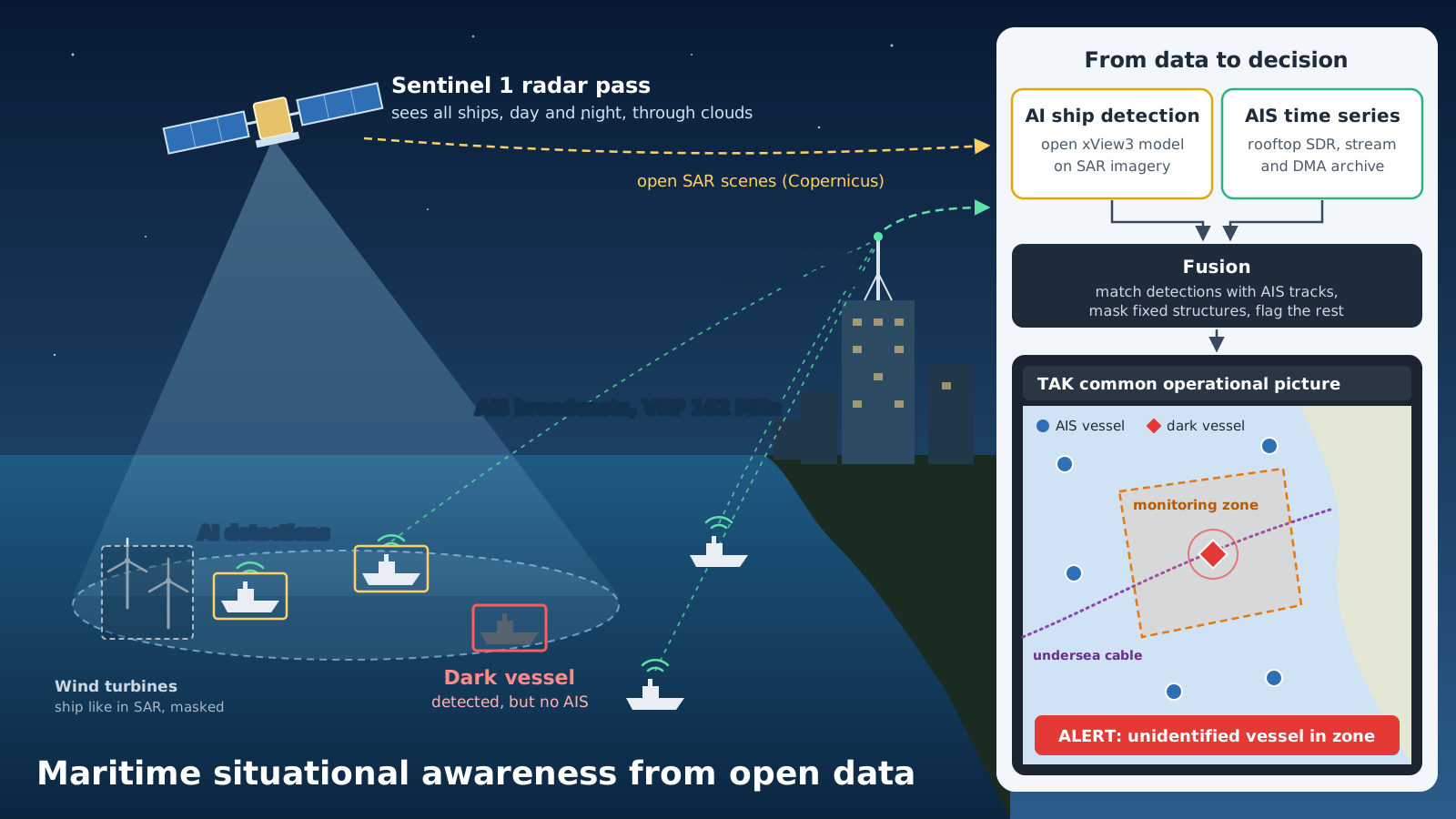
Most ships report their position through AIS, but vessels can switch it off or manipulate it. In Danish waters this is a maritime security concern: vessels transit the straits without reliable AIS, and incidents in the Baltic Sea have shown the vulnerability of undersea cables and pipelines. Satellite radar sees all ships, day and night and through clouds. Open Sentinel 1 data, open detection models from the xView3 challenge and open AIS sources now make it possible to build a situational awareness service entirely from open components.
SAR scenes of a selected area are processed by a pretrained ship detector. AIS data are collected from a rooftop software defined radio receiver, an online stream and the Danish Maritime Authority archive, and vessel tracks are matched with the satellite detections. Detections without a matching track, after masking fixed structures such as wind turbines, are flagged as candidate dark vessels and delivered to TAK with alerts for monitoring zones. The research question is: how accurately can open data and open models detect and identify vessels in Danish waters, and how do the available AIS sources differ in coverage and timeliness?
First, a TAK Server is deployed as the shared platform, and a common detection interface between the two tracks is agreed. Second, Track 1 retrieves and preprocesses Sentinel 1 scenes, applies a pretrained xView3 model and analyses typical detection errors. In parallel, Track 2 installs and characterises a rooftop AIS receiver and collects AIS data from the online and archive sources. Third, the detections and AIS tracks are fused, and the results are delivered to TAK. The complete system is evaluated on detection accuracy, association accuracy and processing time. Real time performance is not required; the project is a proof of concept.
This project examines whether a remote sensor can establish a fresh application-layer key with its application server over Long Range Wide Area Network (LoRaWAN) uplinks. The device uses the Module-Lattice-Based Key-Encapsulation Mechanism (ML-KEM) and sends its encapsulation ciphertext in numbered application payloads. A reproducible prototype will measure how fragmentation, packet loss and device resources affect completion.
Keywords: LoRaWAN, post-quantum cryptography, energy sensors, application-layer key establishment
Contact: Rune Hylsberg Jacobsen (supervisor), rhj@ece.au.dk; Muhammad Waleed (co-supervisor), mw@ece.au.dk
LoRaWAN already protects sensor traffic through its established network and application security. A separate application-layer key may support future post-quantum services, but its establishment has to fit a low-rate radio link. For example, an ML-KEM-768 ciphertext is 1,088 bytes, exceeding a single permitted LoRaWAN application payload. The question is whether the required uplinks and their energy cost are reasonable for a remote powerline sensor.
The sensor starts with an authenticated copy of the application server’s ML-KEM public key. It encapsulates a secret, divides the ciphertext into fragments with a session identifier and fragment numbers and sends them through ordinary LoRaWAN uplinks. The application server reassembles and decapsulates the ciphertext, a protected test reading checks that both endpoints derived the same application key. LoRaWAN join and session keys continue to operate normally. The research question is that how do payload limits, uplink loss and device resources affect completion probability, airtime and energy per established application key?
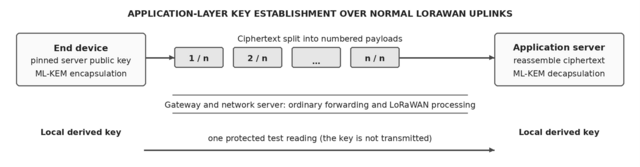
First, a software testbed will model one sensor, the normal LoRaWAN path and an application server, with the selected regional payload and duty-cycle limits. Second, library implementations of ML-KEM-512 and ML-KEM-768 will be combined with fragment reassembly and a single protected sample, normal sensor reporting provides the reference for added cost. Third, uplink loss and data rate will be varied to measure completed exchanges, airtime, setup delay, memory use and estimated energy. A compatible development node can add measured current and execution time without being required for the core study.
Short satellite contacts make key availability a practical constraint on secure telemetry. This project examines an operational key manager that selects between a finite, emulated quantum key distribution (QKD) key pool and the Module-Lattice-Based Key-Encapsulation Mechanism (ML-KEM) for each simulated contact. The comparison focuses on key-selection decisions and successful protected contacts.
Keywords: Satellite communications, quantum key distribution, post-quantum cryptography, key management
Contact: Rune Hylsberg Jacobsen (supervisor), rhj@ece.au.dk; Muhammad Waleed (co-supervisor), mw@ece.au.dk
A satellite may have only a brief opportunity to communicate with a ground station. Stored QKD-sourced keys may be limited, may expire or may be unavailable when a contact begins. ML-KEM provides another route to a fresh shared secret. A ground system therefore needs a clear policy for choosing a key source and recording the choice without consuming the same stored key twice.
A local QKD-service emulator provides matching keys to the ground and satellite endpoints, the model checks validity and one-time use. The alternative is ML-KEM encapsulation to a preauthenticated satellite public key. Both routes supply a symmetric key for the same protected test message. The research question is that how do QKD-first and contact-aware selection policies compare with ML-KEM-only establishment in setup delay, successful contacts and use of finite stored keys?
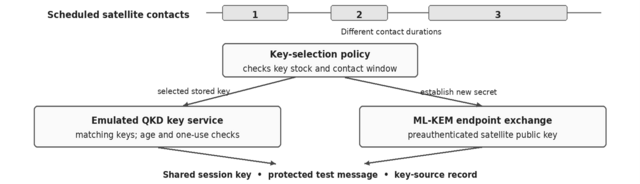
First, a software model will provide scheduled contact windows, finite key arrivals and expiry and two simulated endpoints. Second, the key manager will implement an ML-KEM-only baseline, QKD-first selection and a simple policy that reserves stored keys for shorter contacts. A standard cryptographic library will supply ML-KEM where each contact will produce a protected test message and a key-source record. Third, controlled variations in contact length, key supply and setup cost will establish when each policy completes more protected contacts, how long setup takes and how much stored key material is consumed or expires.
This project investigates whether RaptorQ, an application layer forward error correction scheme, can protect stored payload data against frame loss during a LEO satellite pass over DVB-S2. Payload data queued in a cyclic buffer on the satellite is streamed to a ground station, and the project combines DVB-S2 channel modeling, RaptorQ implementation, and performance benchmarking against both classical SNR driven MODCOD feedback and a baseline system without RaptorQ, with an option to validate results on the department's DVB-S2 hardware testbed.
Keywords: Satellite communications, Forward error correction, DVB-S2
Contact: rhj@ece.au.dk
LEO satellites have only a short pass window, often just a few minutes, to get stored data down to a ground station. Payload data waiting for downlink is commonly held in a cyclic buffer, and frame losses during a pass, from fading, obstruction, or the link dropping below the MODCOD's demodulation threshold, put that short window at risk of an incomplete transfer. DVB-S2 already adapts its MODCOD using SNR feedback from the ground station, but this says nothing about whether the data itself was actually delivered. A key motivation for this project is to test whether an application layer code, layered above DVB-S2, can offer a more direct guarantee that stored data reaches the ground intact, and whether it can do so more efficiently than simply streaming the buffer as is.
RaptorQ generates a stream of encoded symbols from a source object such that a receiver can reconstruct the object from any sufficiently large subset of symbols, regardless of which specific frames were lost. Applying this above DVB-S2 raises a design question: since a DVB-S2 frame's usable payload changes with the code rate part of the current MODCOD, how much RaptorQ overhead is needed, and how should it be configured, to make efficient use of the link's time varying capacity over a pass.
This project addresses the following core research question: can RaptorQ, layered above DVB-S2 and configured to make efficient use of MODCOD dependent link capacity, deliver stored payload data from a LEO satellite more reliably and efficiently than a system that streams directly from the buffer without it?
The project proceeds in three phases. In the first phase, a DVB-S2 simulation is implemented with RaptorQ as an application layer FEC scheme, building on existing open-source RaptorQ implementations, and a representative LEO pass is modeled with elevation dependent SNR variation. In the second phase, RaptorQ's delivery performance is evaluated against the simulated pass, quantifying the symbol overhead needed to reliably reconstruct a source object, benchmarked against a baseline system that streams directly from the buffer without RaptorQ, and against a scheme where RaptorQ's own delivery outcomes are used as an additional feedback signal alongside SNR based MODCOD adaptation. In the third phase, and as an optional extension, the scheme is implemented and tested on the department's DVB-S2 lab setup to quantify its real-world performance.
This project investigates whether a compact, low-cost linear phased array can reliably estimate the angle of arrival (AoA) of an S-band electromagnetic emitter using only phase differences across its elements, without any mechanical steering. A 4-element patch antenna array is interfaced to a phase-coherent multi-channel receiver, and the project combines antenna design, PCB fabrication, and digital signal processing to implement and validate a phase-comparison AoA estimation algorithm against measurements in an anechoic chamber.
Keywords: Phased arrays, Direction finding, Antenna design
Contact: rhj@ece.au.dk
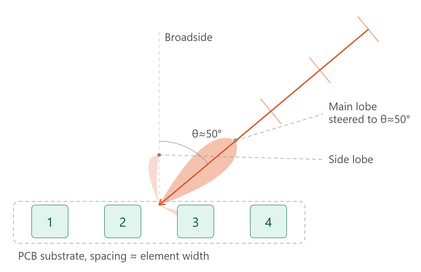
Direction finding of RF-emitting targets is a core capability in radar, electronic warfare, spectrum monitoring, and wireless localisation systems. Mechanically steered antennas are slow and bulky; a phased array instead lets the angle of arrival be estimated purely from the phase differences measured across multiple fixed receive elements. A key motivation for this project is to demonstrate, at low cost and on standard fabrication processes, the full chain from antenna simulation to a working AoA estimate — giving hands-on experience with a capability that underpins much more complex operational direction-finding systems.
A linear array of receive elements sees a plane wave arrive with a small, predictable phase offset between adjacent elements that depends on the angle of arrival, the element spacing, and the wavelength. Recovering that angle accurately depends on three things being solved together: the array and its feed network must be designed so element spacing and pattern are well characterised at the operating frequency; the multi-channel receiver must sample all elements with a shared clock so the measured phase differences reflect only the incoming wave, not receiver timing error; and the estimation algorithm must convert the measured phases into a bearing with known, quantified resolution and error.
This project addresses the following core research question: can a 4-element linear phased array, built on standard PCB fabrication and read out by a phase-coherent multi-channel receiver, estimate the bearing of an S-band emitter to an accuracy consistent with array theory, when validated against a source at known bearings?
The project proceeds in three phases. In the first phase, the antenna array is simulated in ANSYS HFSS and fabricated as a 4-element linear patch array with λ/2 element spacing. In the second phase, the array is interfaced to a phase-coherent multi-channel receiver and a phase-comparison AoA estimation algorithm is implemented on the captured data. In the third phase, the system is validated with over-the-air measurements in an anechoic chamber against a reference transmitter placed at known bearings on a common plane with the array, and the achievable angular resolution is characterised against the theoretical estimate for a 4-element linear array.
This project investigates whether a Virtual Machine (VM) can serve as a persistent network counterpart to a physical object moving through a supply chain. As the object passes successive RFID readers, the VM migrates to the nearest host, maintaining a stable IPv6 address cryptographically bound to the object's EPC identifier. At each checkpoint the VM performs local computation and writes a signed record back onto the physical tag, creating a physically embodied audit trail that remains intact independent of network continuity. The project combines Xen live migration, Software Defined Networking, and Cryptographically Generated Addresses (CGA) to realise and evaluate this concept in a testbed environment.
Keywords: Internet of Things, RFID, IP networking
Contact: rhj@ece.au.dk
IoT promises a world where physical objects are continuously reachable and addressable over the Internet. In supply chain management, RFID technology has become a cornerstone for tracking goods as they move between locations. However, a fundamental gap exists between the physical movement of tagged objects and their persistent network presence. When a passive RFID tag moves between readers, any associated network state is lost, making it impossible to maintain a continuous, addressable identity for the object.
This project proposes that a VM acting as the network counterpart of a physical object should migrate along with the object as it moves through the supply chain. A key motivation is that latency-critical local decisions can be made by the VM at the point of reader encounter, without incurring the round-trip delay of consulting a central server. Crucially, when the VM computes a decision or issues a compliance certificate at a checkpoint, it can instruct the local reader to write that result back onto the physical tag. The tag thereby becomes a physically embodied audit trail, carrying verified state from each checkpoint independently of network infrastructure. The VM and the tag act as complementary state carriers: the VM provides rich networked computation, while the tag provides a physically resilient record that survives even if network continuity is interrupted.
Passive RFID tags cannot host a network stack. However, as established in prior work, a reader can assign an IPv6 address to a VM acting as the tag's network counterpart, constructing the address from the tag's EPC using CGAs. The challenge arises when the object moves to a new reader: the network prefix changes, the old address becomes unreachable, and network continuity is lost.
This project addresses the following core research question: Can a live VM migration, triggered by and synchronised with the physical movement of an RFID-tagged object between readers, maintain continuous network reachability and preserve computational state across subnet boundaries, while using write-to-tag operations to maintain a physically embodied audit trail on the tag itself?
Three interrelated problems must be solved. How can the VM's network identity be cryptographically bound to the tag's EPC such that the identity remains stable as the VM migrates? How can reader events trigger VM migration in a timely manner, given that a passive tag can only report data at the moment of a reader encounter? And how can the underlying network, using SDN techniques such as OpenFlow, ensure that the VM's IP address remains routable after migration to a host on a different subnet?
The project will proceed in three phases, building on preliminary work already undertaken in constructing IPv6 addresses from EPC identifiers using CGA techniques.
