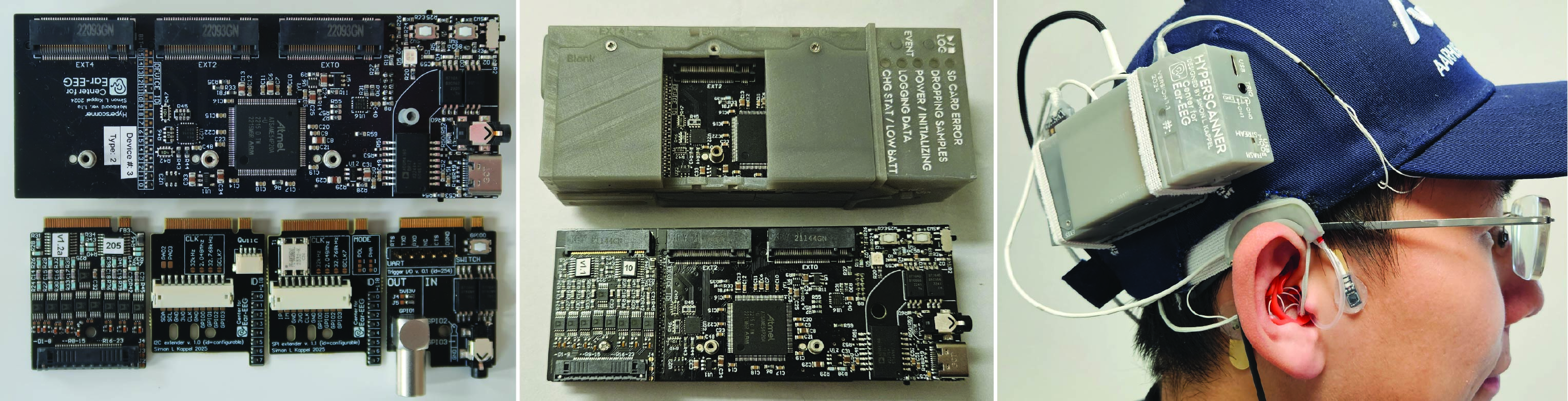
The Hyperscanner project aims to develop an advanced, modular platform for multimodal biomedical data acquisition, with a particular focus on high‑performance analog instrumentation for electrophysiological measurements using dry‑contact electrodes. The platform is designed to support experimental research, rapid prototyping, and systematic evaluation of sensor technologies and front‑end architectures in realistic biomedical and neurophysiological settings.
At the core of the project is the design of a low‑noise analog front‑end optimized for dry‑electrode sensing. Building on extensive prior experience with such measurements, the front‑end emphasizes very high input impedance, low current noise, active shielding of electrode cables, and high common‑mode rejection, enabling robust acquisition of weak physiological signals in environments with significant interference and motion artifacts.
The hardware architecture is centered around a mainboard that integrates power management, clock distribution, and data handling. The system provides galvanically isolated input/output compliant with IEC 60601, ensuring electrical safety for human‑subject research. A generic, extensible interface allows connection of up to six synchronized extension boards, enabling precise temporal alignment across multiple sensing modalities.
As part of the project, several extension boards have been developed, including modules for electrophysiological recording (EEG, ECG, EMG), photoplethysmography (PPG), and movement tracking using inertial measurement units (IMUs). In addition, the platform supports integration with embedded Linux‑based computing modules, which supplement the mainboard microcontroller with increased computational capacity for tasks such as real‑time audio processing, online signal analysis, and IoT‑enabled system integration.
The Hyperscanner firmware is designed with a generic driver framework and supporting libraries for interrupt‑based data acquisition and processing. This software architecture enables rapid development of new sensing modules and facilitates systematic investigation of sensor performance, analog front‑end designs, and multimodal synchronization strategies.
Overall, the Hyperscanner project provides a flexible, scalable, and research‑oriented instrumentation platform that supports method development and experimental studies in biomedical sensing, human physiology, and multimodal neuroscience.
Funding: The Hyperscanner project is funded by the Center for Ear-EEG.


