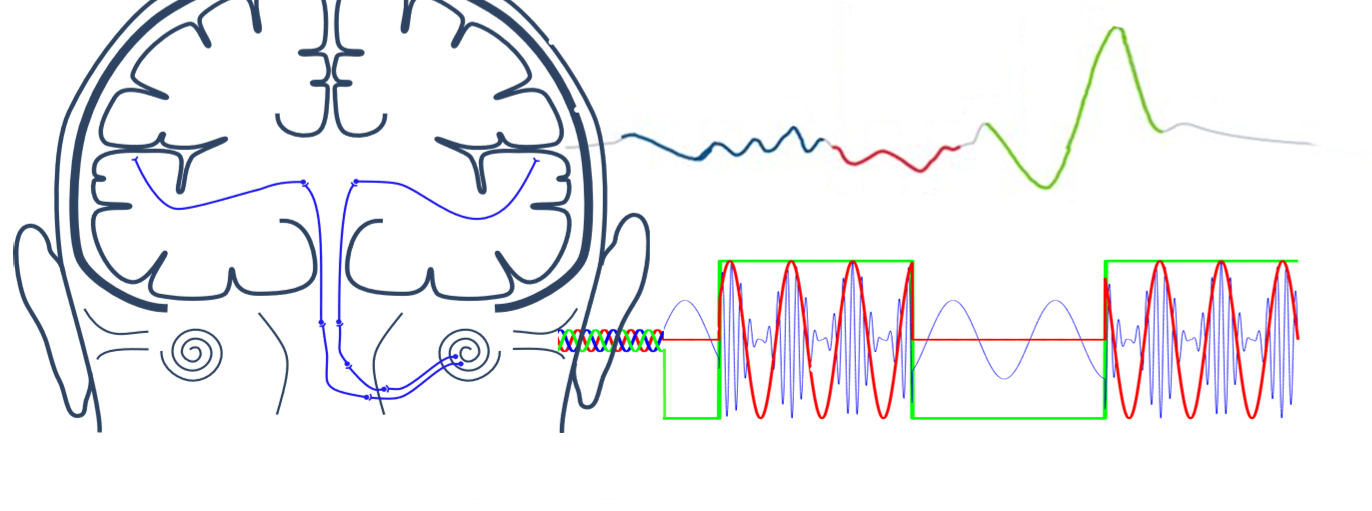
Understanding how the auditory system processes sound is a crucial step toward improving hearing rehabilitation. Auditory evoked responses provide a unique window into neural processing, reflecting coordinated activity along the auditory pathway in both normal and impaired hearing. Studying these responses enhances our understanding of the fundamental information-processing mechanisms of the auditory system, supports more precise assessment and characterization of hearing impairments, and strengthens the foundation for developing effective rehabilitation strategies.
The overall objective of this project is to isolate and characterize intrinsic auditory encoding mechanisms and their neural generators. In particular, the project focuses on how auditory responses are represented in ear-EEG compared to conventional scalp EEG. Controlled auditory paradigms with systematic experimental manipulations are employed to selectively engage specific encoding mechanisms. Advanced signal processing techniques, including spatial filtering, spatiotemporal decomposition, and deconvolution, are applied to disentangle overlapping neural activity and map responses to distinct stages of auditory processing.
Hearing impairment is a growing global challenge, associated with significant socio-economic costs and a profound impact on individuals’ quality of life. By advancing our understanding of how the auditory system encodes sound, this research aims to enable more accurate assessment and characterization of hearing impairment, inspire the development of improved signal processing algorithms for hearing aids, and ultimately contribute to next-generation hearing devices capable of adapting through electrophysiological feedback.

The project is funded, through the Center for Ear-EEG, by the William Demant Foundation and T&W Engineering.


