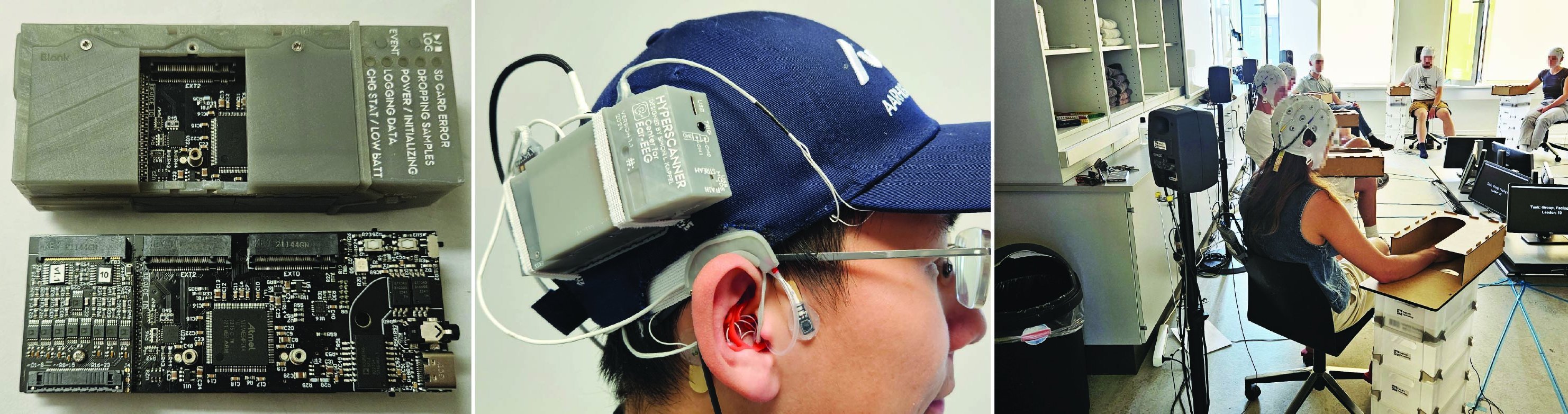
Biomedical sensing has undergone a rapid transformation in the past decade, with an increased clinical focus on ambulatory monitoring and physiological sensors integrated in consumer wearables such as smartwatches, earbuds, and smartphones. In reseach the trend is going in the same direction, with experimental studies moving beyond controlled laboratory environments and into real‑life, ecological settings.
The research group develops novel instrumentation for electrophysiological and multi-modal sensing, enabling both single‑subject and multi‑subject (hyperscanning) studies in naturalistic environments. Our expertise spans the entire signal chain from analog front‑end design to embedded systems, transducer development, synchronized data acquisition, and advanced signal processing of complex time‑series data.
This holistic, end‑to‑end approach positions us to address key challenges associated with high‑quality data collection in everyday life. Application areas include sleep research, social interaction, and long‑term physiological monitoring.
We have a strong track record in ear‑EEG instrumentation, multimodal biosignal acquisition, and wearable sensor integration, with multiple contributions that enable real‑life electrophysiology beyond traditional clinical setups. An increasing emphasis on hyperscanning allows us to conduct synchronized, multi‑participant recordings to study social and interactive dynamics through jointly measured neural and physiological signatures.
A central ambition of the group is to bridge the gap between laboratory‑grade measurement precision and real‑world practicality. Our work encompasses the entire sensing signal chain—from analog instrumentation and transducer design to digitization, firmware development, and storage or real‑time streaming of raw physiological data.
This integrated engineering perspective has enabled us to develop robust sensing platforms capable of acquiring high‑quality EEG, ECG, EMG, PPG, IMU, and related biosignals under challenging real‑world conditions. Our systems support both short‑term experimental studies and long‑term ambulatory deployments, including overnight sleep recordings and complex interactive experiments.
These contributions underpin ongoing collaborations in clinical sleep research, behavioral neuroscience, and human–computer interaction, advancing the study of physiology in real‑life contexts without compromising data quality.
